Automating Compliance & Profit for a National Cash Collection Business

Case Study: Ensuring Compliance & Optimizing Profit for a National Cash Collection Business
One of our clients had a cash collection business across the breadth of the United States.
Their clients relied on the proximity of deposit locations in rural areas where banks did not have branches or outlets to deposit cash taken in their businesses.
My client relied on a 'Securicor-type' Security firm to collect the cash from these machines, bring them to the bank and deposit them safely.
Their drivers did this as part of their rounds. My client would get charged for each pick-up the Security firm made.
Each machine was computerized to generate a CSV file of the level of 'fullness' of the machine. And the Security firm was instructed not to empty machines that were partially full, but also instructed to empty machines before they were completely full.
Tolerances:
Being too full and not emptied risked my client's customers being unable to make a deposit, while emptying a machine that was almost empty meant my client would get charged more frequently for unnecessary pick-ups. The former would cause frustration and dissatisfaction for my client's clients who may have had to drive miles to get to the nearest Cash machine, while the latter dented my client's profit margins.
Local Geography
While each State county's Security firm worked with their county's local Deposit location, and received information (the .CSV file) for that particular cash machine, my client at head office received all the nations (50 states) CSV files 3 times per day. (100's of files.)
The Challenge
The challenge for my client was to ensure that the terms of the contract to which the Security firm had agreed were being complied with and adhered to, to ensure that no machine was collected after it was full, and no over-billing was done because of aggressive collections.
The Data
The data files arrived containing Meta-data such as Name of depositor, Date and Time of deposit, the Amount of deposit, as well as the denominations, and the capacity of the cash machine.
Before I was contracted
The data arrived, the manager tasked with compliance would have to collate all the data, then use manual data processing techniques in Excel to get the relevant information. This took up most of his day and he was certainly unable to do this 3-times a day at each data-set's arrival. This meant that invariably if a machine was collected late, the manager would not be able to spot it in time.
I was put on the job to...
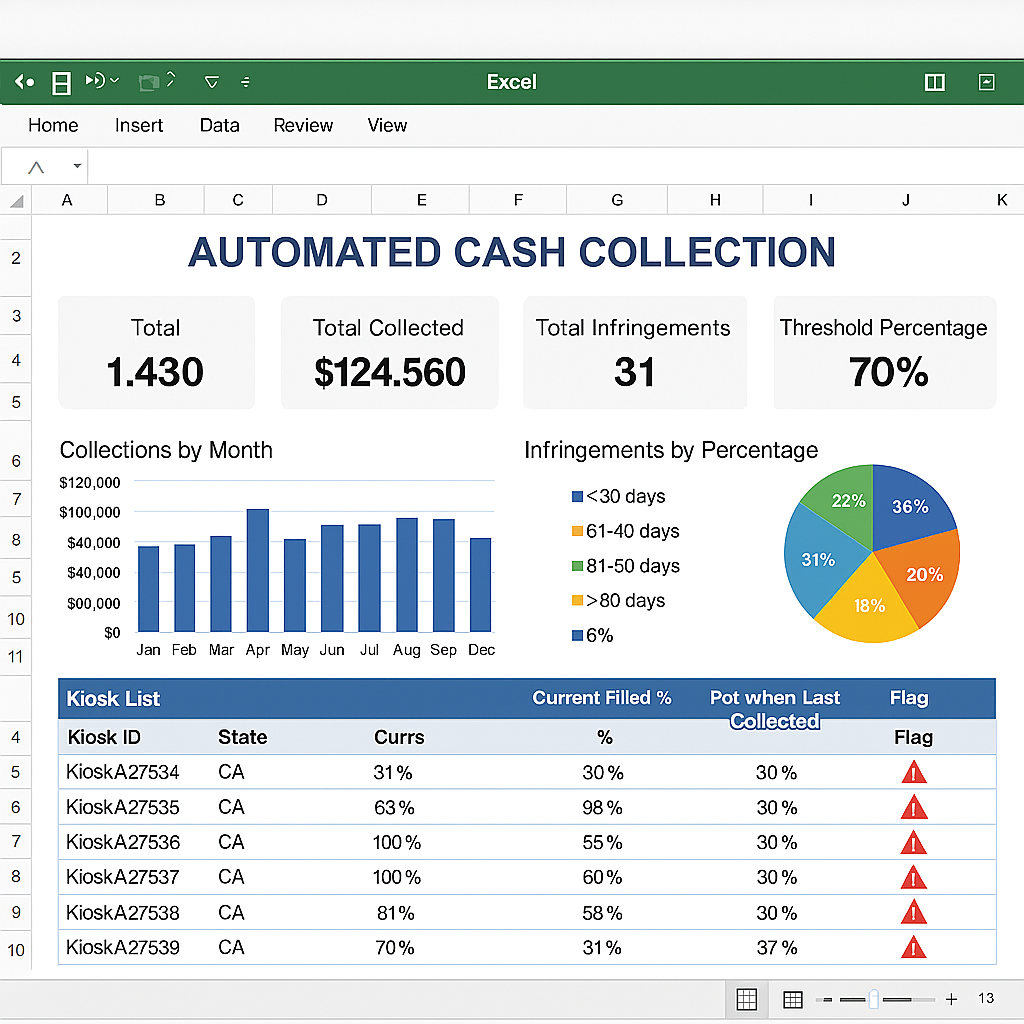
Image by AI
My presence on the job instantly meant that my solution would enable the manager to run the task as often as he wanted. Yes, 3 times a day, and have the information at his finger tips within a short while, and all this while he tended to his other responsibilities.
The first thing I did once the data was collected and processed for fullness was to flag the 'current' level of fullness of each machine and to flag the level of fullness at the time of collection.
I then ensured these were highlighted in a dashboard that was created on the fly, that allowed the Manager to concern himself only with the machines whose fullness/collection was of concern, and not all the data, which again saved the Manager investigation time.
But I took it further. I allowed the manager to set the fullness threshold, based on which his dashboard would be redrawn for what-if analyses, to optimize profit. (This part was not requested and a gift from me).
Visualizing the transformation from a manual, high-risk problem to a strategic, automated solution:
I did this work for Tio Networks in 2007. They were acquired by Paypal in 2017 for $238M and have now ceased trading.
"Farzad did a brilliant job producing a custom-made spreadsheet to meet my business needs. He is extremely creative, a true mastermind at Excel. I commend Farzad for his expertise and will refer my friends and colleagues to Excel-ent Solutions."
Transform Your Data Processing
Can intelligent software written specifically for your data processing needs help your company optimize and become more profitable?
If you believe the answer is YES, then please reach out via the “Book a meeting” button above. Let’s discuss your needs on a call with no obligation..